
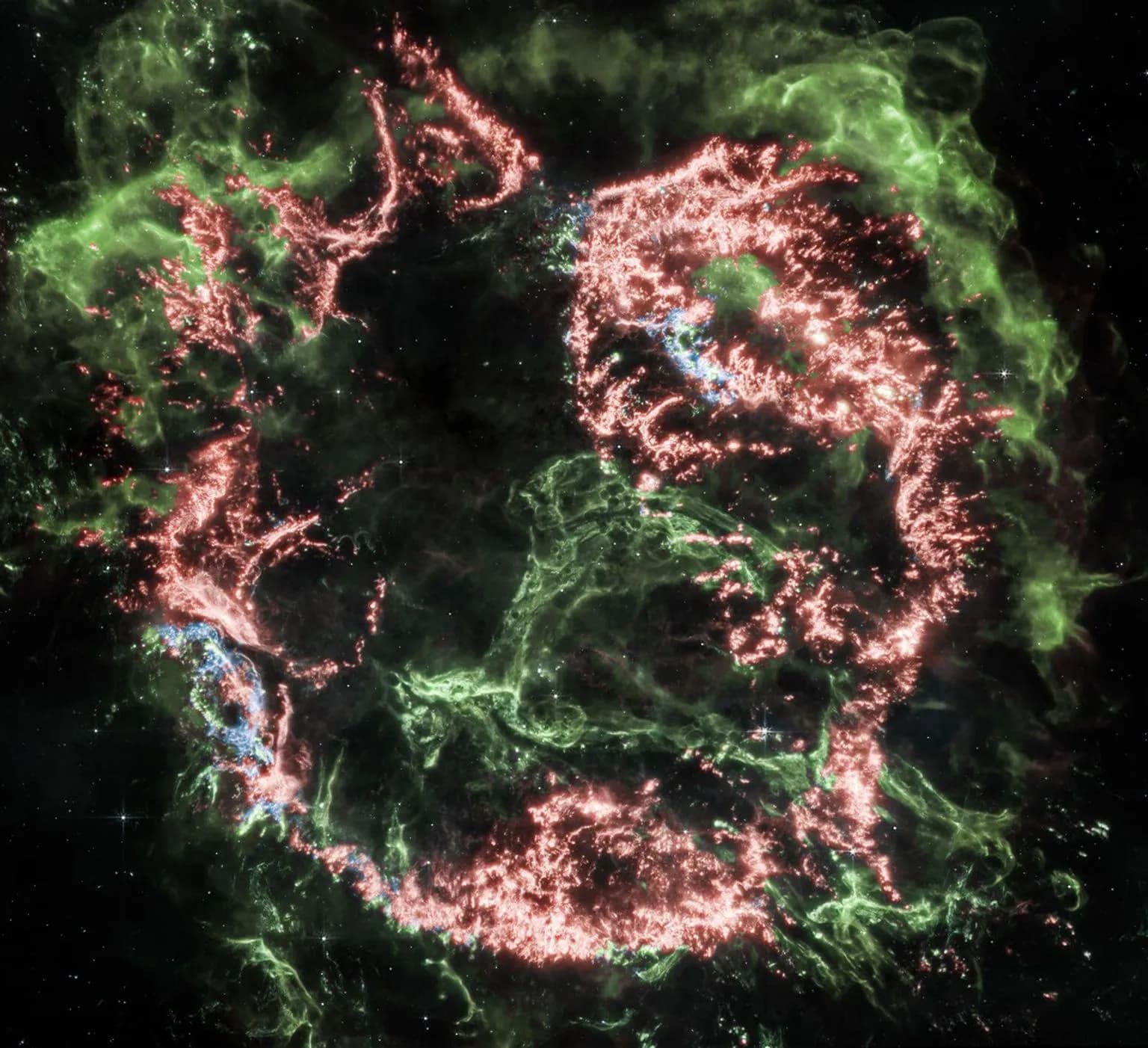
NASA's James Webb Space Telescope has observed the supernova remnant Cassiopeia A to study hot dust and provide clues regarding the structure of its original star, according to NASA.
Researchers leveraged data from NASA's retired Spitzer Space Telescope to identify three specific regions for observation using the James Webb Space Telescope. The target remnant, Cassiopeia A, is formed from the debris left behind after a massive star exploded, scattering heavy elements into space, and sits approximately 11,000 light-years away in the constellation Cassiopeia.
Material within these shells churns and circulates, which can cause the shells to merge shortly before the supernova explosion,
The high-resolution capabilities of the observatory have also enabled scientists to examine the chemical structure of the remnant's cosmic particles in greater detail than previous missions allowed.
With Webb, the vast improvement in being able to resolve at the individual clump level helps us do more sophisticated dust chemistry,
The James Webb Space Telescope was launched in December 2021 to observe the universe in infrared wavelengths, allowing astronomers to analyse deep-space environments and cosmic remnants.